
Searching Cases by Name
Start with the case type. An 18th Judicial District Court file may be civil, family, probate, or criminal. That choice shapes where the record lives. The Iberville Parish Clerk does not offer an anonymous name-search form on its search channels. Instead, the public eSearch landing screen shows account controls. The Clerk points civil searchers toward Clerk Connect. And eClerks LA layers statewide and parish options on top. Once you reach an authorized portal, search the full legal name. Try reasonable spelling variants too. Keep one caution in mind: a name hit alone proves nothing about identity, since common names can fill a results list. Match the court, the division, and the caption before you trust the result.
- Read the notice, pleading, citation, or order and identify the court that issued it.
- For an 18th Judicial District Court file, note the record type, names, approximate year, docket number, and division.
- Use the appropriate official account path, then search the collection available to that account without assuming an anonymous name field exists.
- Compare any result with the division and caption, then contact the Clerk when an official or complete record is needed.
| Field or control | Type | Required | Verified use |
|---|---|---|---|
| User ID | Text | Yes at eSearch login | Credential field, not a public name query. |
| Password | Password | Yes at eSearch login | Case sensitive; do not share it. |
| Parish selector | Selector | Varies | eClerks LA route for confirming Iberville participation. |
| Party name | Search field | Not exposed anonymously | Use only where the authenticated service makes it available. |
Note: Verify the court, division, and caption before treating a result as the case you want. A shared name is easy to mistake for the right file.
Iberville Parish eSearch Case Access
Iberville eSearch opens on an account screen. You'll see User ID and a case-sensitive password. Password Reminder, Create an Account, Certified Dates, and site-requirement controls appear too. What you won't see is a query form. The anonymous screen offers no docket-number, last-name, date-range, or case-type search. Check Certified Dates before assuming a blank result means nothing exists. A matter can carry an official number before the clerk indexes and releases it.
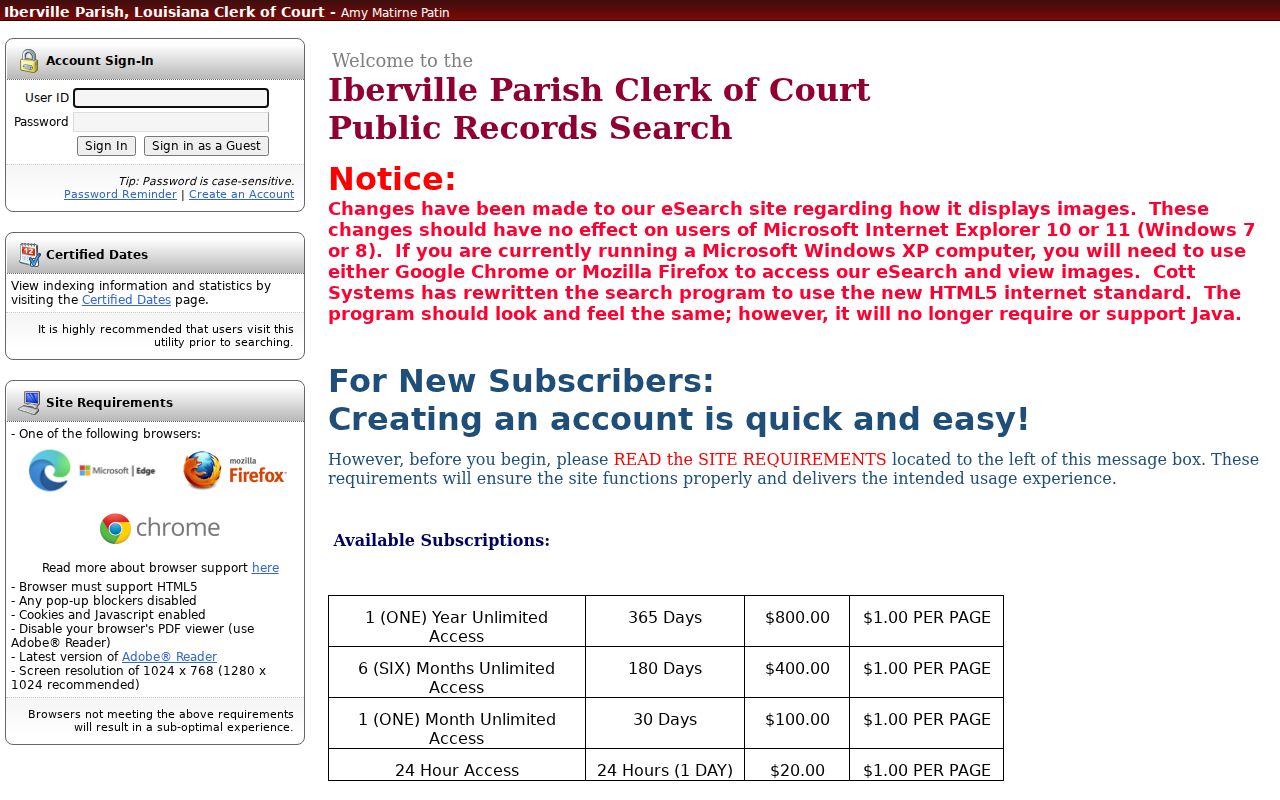
That login view is an access path, nothing more. It is not a sample docket. The Clerk describes the remote material as released records. The Clerk also warns that the online version is not the official public record. After a lawful login, keep civil and criminal coverage straight. Civil indices run from 1990 and civil images from 2008. Criminal indices begin in 2000, with criminal images starting in 2014.
Searching by Case Number
A docket number is the strongest search tool you can hold. It appears on a summons, order, pleading, or citation. It points straight to one file. Iberville forms use a blank docket-number field plus a separate Division field. The official public materials publish no standard numeric pattern. Never invent a prefix. Never guess a case type from the digits. Type the number exactly as printed. Then confirm the division and caption with the Clerk or the assigned court office. If the matter has no number yet, keep the filing date and the exact names from the document. That lets the Clerk route it. One local form shows the identifier as No.: docket number / Division: A-D. That wording only reflects the printed form fields. It does not establish a standardized Iberville number format.
Iberville Parish Case Search Numbers
Division matters here. The 18th Judicial District Court runs four divisions. Local forms label them Division A through D. Criminal work in Iberville falls chiefly to Divisions C and D. Civil matters can be heard anywhere within the shared three-parish district. A division never replaces the docket number. But it helps a records request land on the right desk. It also helps separate a case from a similarly named one.
- Docket number
- The court's identifier for the proceeding, labeled that way on Iberville forms.
- Division
- The assigned 18th Judicial District Court division, shown locally as A through D.
- Caption or style
- The formal case title. Verify it as displayed because the portal's exact public labels were not available anonymously.
- Released record
- An indexed and verified record released for general viewing through the Clerk's imaging service.
For a Plaquemine City Court, St. Gabriel Mayor's Court, or justice-of-the-peace matter, don't rerun the parish search as if it were the custodian. Each of those courts keeps its own lower-court files.
What a Case Search Returns
No private Iberville case is open to the anonymous public. For a reliable picture of what exists, rely on Clerk materials, e-filing rules, and published forms. An authenticated search may return released, indexed material. What the online version shows, from event labels to party display to financial and setting fields, should be treated as a lead only. Confirm anything that matters against the official record.
| Docket number | Local proceeding identifier, with no published standard format. |
|---|---|
| Division | Local forms provide a Division field for 18th Judicial District Court files. |
| Caption or style | Party names or a case title; verify spelling and the court before relying on a match. |
| Document or event | Filed items can include motions, orders, judgments, citations, notices, and other recorded proceedings. |
| Record status | Released material may be viewable online; official and certified versions come from the Clerk. |
Iberville Parish Case Search Courts
Check the court level before repeating the same parish search. The 18th Judicial District Court handles Iberville civil and criminal matters across its three-parish district. Plaquemine City Court keeps its own civil, small-claims, misdemeanor, juvenile, and traffic files. St. Gabriel Mayor's Court runs a separate municipal traffic channel. Six justice-of-the-peace districts hold separate lower-court records. Let the document that started the matter tell you the court. A city ticket or lower-court case may never appear as an 18th Judicial District Court record. The clerk keeps its own file. So does the city court, Mayor's Court, and each JP.
Iberville Parish Case Search Subscription
The Clerk Connect login is the civil route. The Iberville Clerk asks searchers to subscribe to it. Its public landing page describes search and printing capability for enabled clerks. The anonymous view shows no Iberville field list, no price schedule, and no result screen. Check parish availability and charges inside the live service. Don't assume them from the generic portal shell.
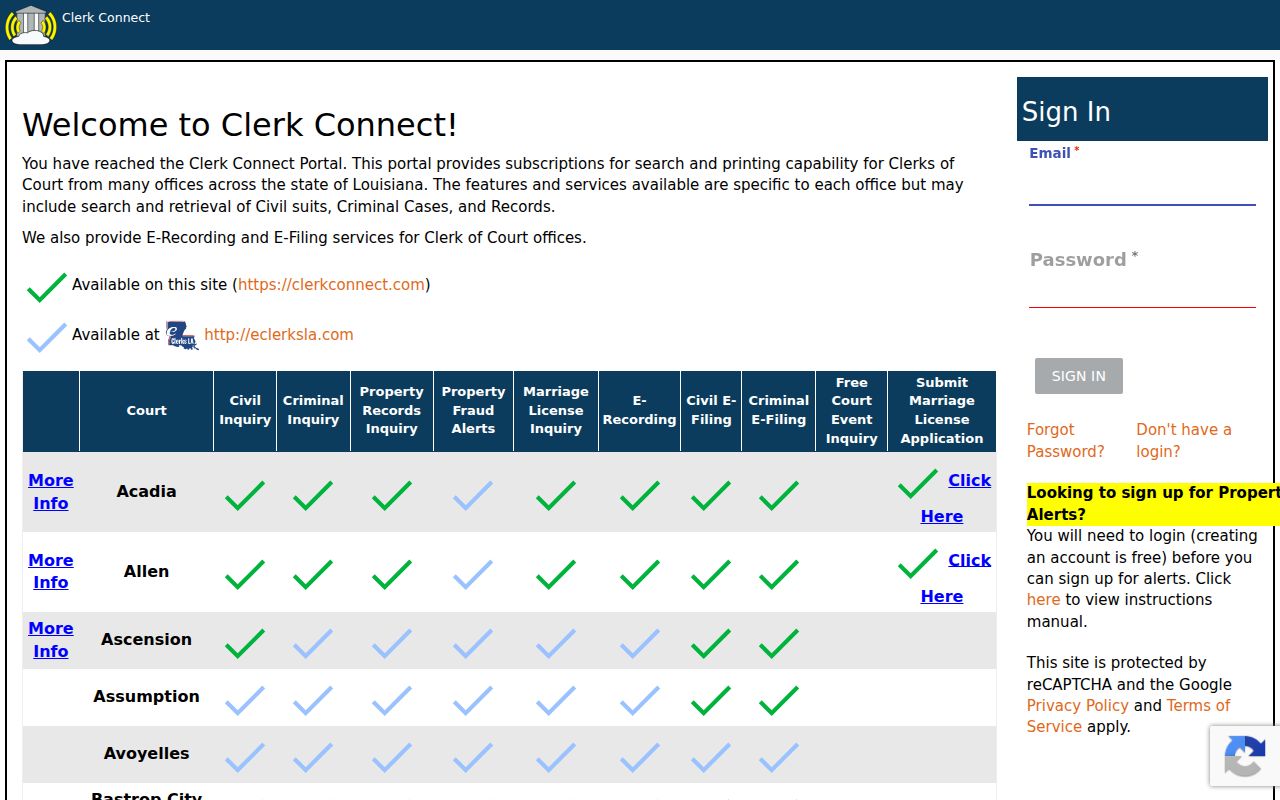
The visible account controls cover login and subscription management. They don't promise that every Iberville civil file or image is reachable without an active parish-enabled account.
Iberville Parish Case Search Coverage
Dates tell you what an Iberville Parish case search can reach. Civil indexes go back to 1990. Civil document images start in 2008. On the criminal side, indexes reach back to 2000, while images only begin in 2014. So an older matter may show up in an index yet have no image you can pull remotely. Those start years are not a promise of a full archive. They say nothing about city-court or justice-of-the-peace cases.
Match the question to the collection. A hit in the civil index proves nothing about a criminal image. A blank image does not mean nothing was filed. Records Management, or the Civil or Criminal Records Department, can lay out what path exists for an old case. For preservation questions, ask directly whether the matter survives on paper, microfilm, or as an archived index record rather than trusting remote availability.
Statewide vs County Case Search
eClerks LA is the statewide layer, run through the Louisiana Clerks' Remote Access Authority. It offers a free statewide location and index function. It also covers parish search, civil information, criminal search, e-filing, and alerts. Iberville's own Online Imaging/eSearch and Clerk Connect routes stay separate from it. Treat the state layer as a locator. Use it to find a participating-parish path, then confirm the court and office behind any Iberville result.
| eClerks LA statewide layer | Iberville local paths |
|---|---|
| Offers statewide location/index functions and participating-parish services. | Online Imaging/eSearch, plus Clerk Connect direction for civil searches. |
| Uses service tiles, parish selection, and account controls. | eSearch begins with User ID/password; exact post-login fields were not inspected. |
| Coverage varies by participating clerk. | Released records may have separate index and image start years. |
| Useful for locating the right layer. | Useful for following the Clerk's local records path. |
The eClerks LA account screen carries email and password fields with registration, confirmation, and recovery controls.
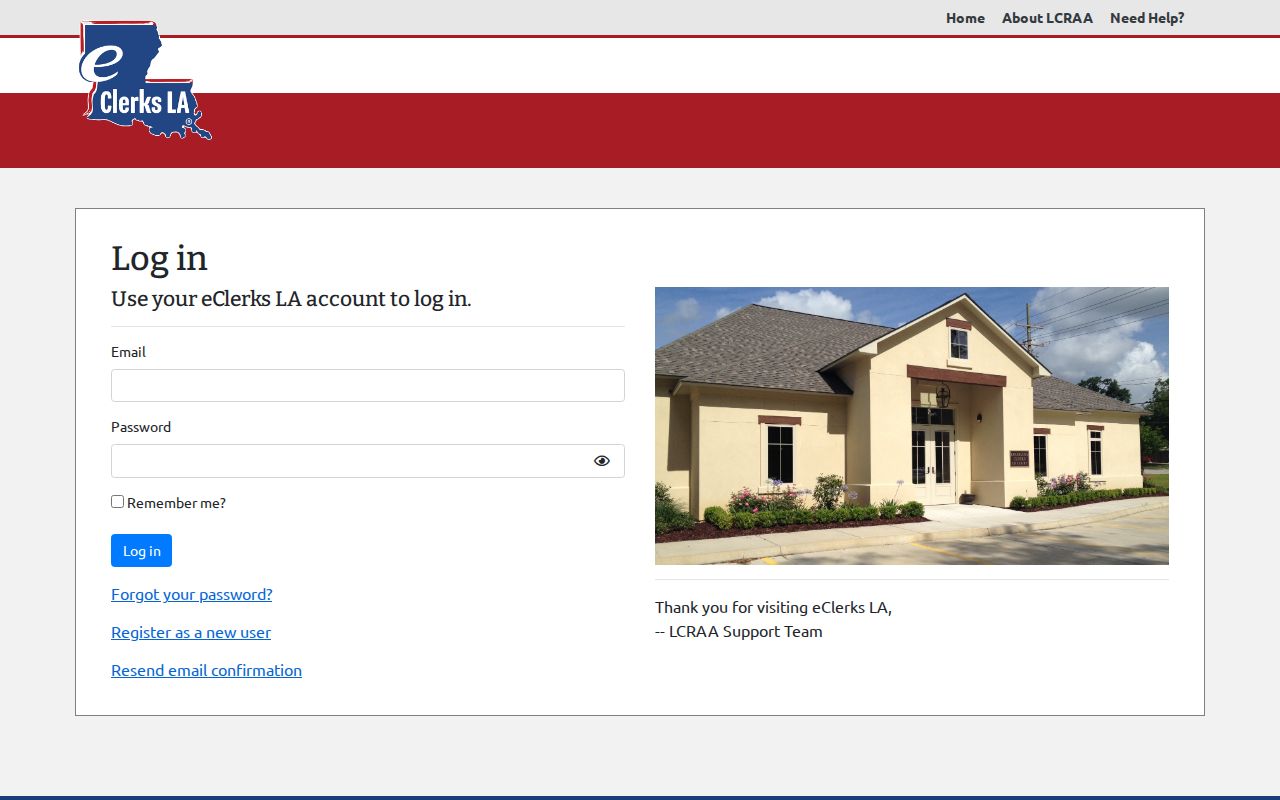
An account there still does not make every Iberville docket entry or image available from afar.
Iberville Parish Case Search Payment Limits
A city payment page is not a docket. Plaquemine's official city pages link an online route to pay a traffic fine. But no citation search or case detail screen sits behind it. St. Gabriel's dashboard takes a citation number and last name. Enrollment in the defensive-driver program is required. It is not a public case register.
Read a payment confirmation as proof of that transaction alone. For the court date, the case file, or the outcome, call the court hearing the matter. A dead link or empty result does not mean the citation was dismissed, never filed, or missing from the court record.
Iberville Parish Case Search Fallback
A blank screen settles nothing. Before assuming a case is invisible, check several things. Start with the court level. Then check the civil versus criminal collection, date coverage, spelling, docket number, and division. Next, consider whether the record still awaits indexing or release, sits in a city or JP court, or is restricted. The Clerk's coverage dates explain how an old index can exist while no remote image does.
When the answer matters, move from portal to office. The Clerk sits at 58050 Meriam Street in Plaquemine, main phone 225-687-5160, email apatin@ibervilleclerk.com, and mail at P.O. Box 423, Plaquemine, LA 70765-0423. A tight request names the court. Add the docket number or caption, a date range, the document type, and the division when known.
Note: If a restriction may apply, ask for the lawful access process or a redacted release. Do not ask for protected content.
Iberville Parish Case Search Custodian
When a portal leaves the question open, send the request to the office that keeps the record. That office is easy to spot. For an 18th Judicial District Court case, start with the Iberville Parish Clerk's Civil or Criminal Records Department. The District Attorney's public-record process covers only what that office holds. It plainly warns it is not the custodian for many Clerk-held files.
Louisiana public-record rules favor a narrow request. Name the court, docket number, division, date range, and the document you want. A transcript request goes through the court reporter channel, not the Clerk's image route. That routing saves time. It also keeps a statewide index from being mistaken for the record custodian.
Access and Restricted Cases
Louisiana public-record rules back inspection and copying unless an exception applies. Juvenile proceedings are confidential under La. Ch.C. art. 412. Expunged records that qualify come out of public view under La. C.Cr.P. art. 971 and related provisions. Sealed files can also drop out of ordinary search results. So can protected family material, personal identifiers, and unreleased records.
For records that should be public, La. R.S. 44:31 recognizes the right to inspect or copy, subject to lawful exceptions. Send the request to the actual custodian. The District Attorney cautions that it is not the custodian for many Clerk-held case materials. It may also withhold pending-investigation or privileged work product.